And so it begins....

Garden goodness
This was the harvest from the other day: potatoes, okra, zuchinni zuchhini zucchini (my second of the year - woot! Sigh), carrots, tomatoes, tomatoes, and more tomatoes. Not pictured: the two large bowls of tomatoes already waiting for me.

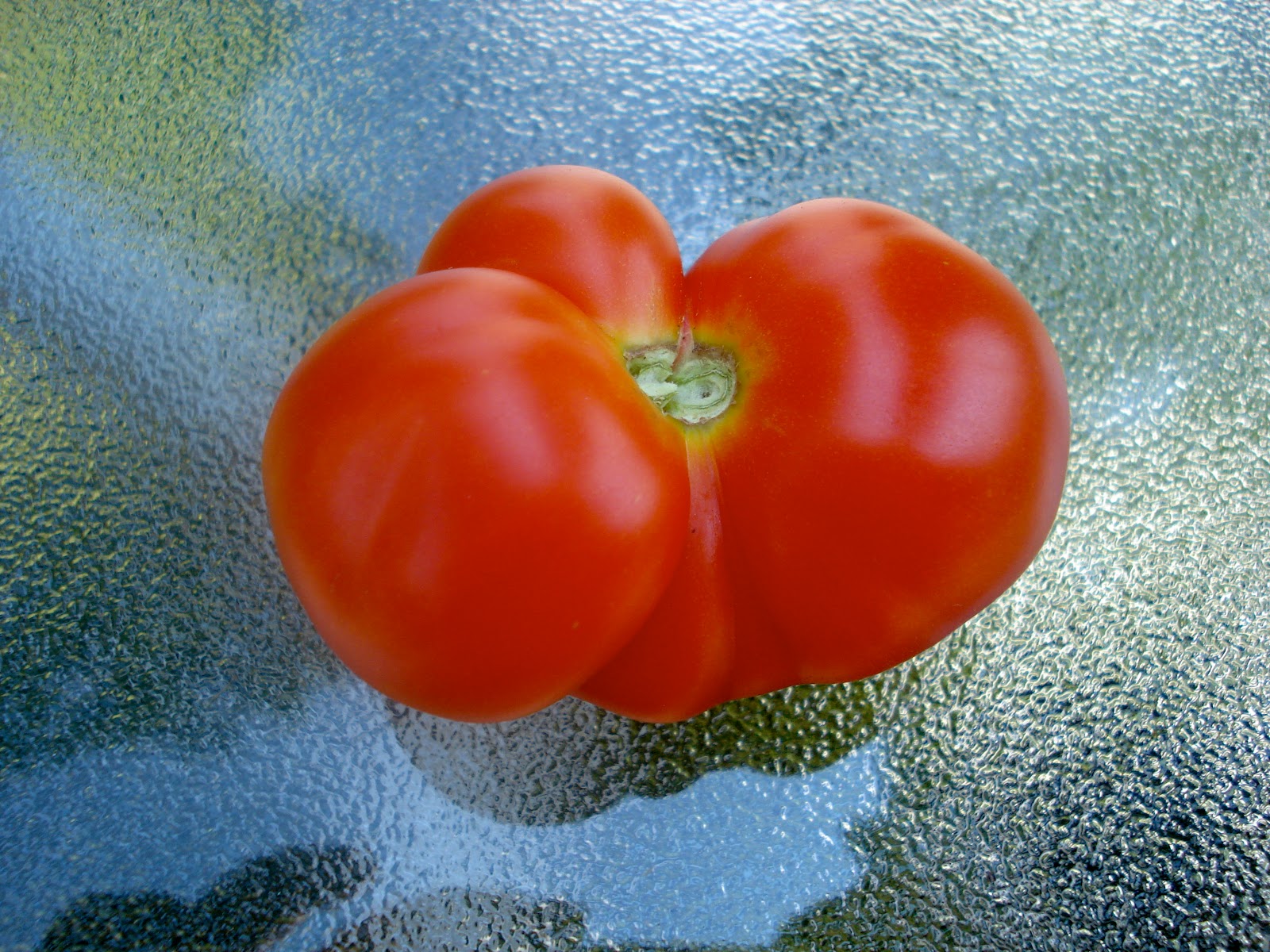
Also not in the basket - the monster Federle tomato, which finally ripened:

It's huge!

With Kiphead for scale
I'll make another large batch of soup, and I'll grill some to add to the previously grilled jalapeno peppers (I have an idea for a smokey salsa thingy - no recipe yet, but I hope it works), and I'll make a batch of roasted tomato sauce - yum! And then, the real canning will start!


Good thing I know what to do with any tomatoes that are left over...


Conversations with Dog


Katy: I want to go outside.

Me: It's raining.

Katy: I want to go outside.

Me: It's raining really hard.

Katy: I want to go outside.

Me: REALLY, REALLY hard.

Katy: I want to go outside.

Me: You'll get wet...

Katy: I want to go outside.

Me: Fine. Go.

Katy: I want to go inside.


5 minutes later? Repeat entire conversation.

but good news - IT'S RAINING!!!!!!!!!


__________________________________________
*no, my dogs don't really talk to me. Somedays, I wish they did - it'd be easier... maybe.

The Gardener's Best Day

The best day for a gardener? The first day you manage to make a meal, entirely from garden harvest.

For me, that day was July 30th. I turned this:

Celery, potatoes, carrots, onions, green beans, tomatoes, okra and cabbage
Into this:
Yummy vegetable soup
A few minutes cleaning and chopping the veggies, a bit of time in the soup pot with some water, salt and pepper, and a meal that costs next to nothing.

The next day, I turned this:
Yellow, green and red tomatoes, a green pepper and red onion.
Into a Greek salad (sorry, no pic!). I added feta cheese, oil and vinegar, plus salt and pepper. Those items, of course, weren't from my garden, but still. That day, I had a toasted tomato sandwich for breakfast, the salad for lunch and leftover soup for supper. That's an entire day's worth of food, mostly from the garden.

This is the time of year when the garden starts producing enough to eat for most meals - and soon, will start producing enough to start preserving. In fact, the bowlful of paste tomatoes I picked yesterday have a date with some onions, garlic and celery, and will soon be magically turned into the first pot of sauce. The hot peppers are coming on strong, and will be roasted and picked and dried. The onions are ready to pull and cure, the first bed of potatoes is ready to be completely harvested - and replanted with fall crops.

This is the busy season in the garden, but the results make it all worth while!

Geeking the Olympics

I not afraid to admit it - I love the Olympics. Yeah, yeah, yeah, I know all the issues with it - the cost, the possibility of "doping", the whatever-else-people-want-to-complain-about.

I know all that, and I still love them. I love watching the opening ceremonies, with everyone full of hope. I love watching the parade of nations (and trying to figure out how many of them I could place on a map). I especially love seeing the athletes from small countries - how amazing it must be to be one of a handful picked to represent your country at such a large event. I love watching the closing ceremonies, and seeing the athletes come together as one large group, instead of divided by country.

And I especially love being able to watch seldom-seen events. How often do you get to see badminton on TV? Or archery? Or discus? Do most people even know what the three day event* even consists of? Or what of the modern pentathlon* - a sport that seems to be designed for Hemingway-esque heroes (minus the drinking, of course).

The one thing I don't like? All the whinging I hear about how "that's not really a sport".


Equestrian "isn't really a sport" because "the horse does all the work".

Cycling, luge, bobsled, canoe, kayak, skeleton, rowing, sailing - all sports with "vehicles", without which the athlete would be, well, up a creek without a paddle (ha!). But it's somehow different because a horse is alive, and is somehow considered to be able to compete on it's own.

As someone who has actually ridden (poorly) a horse trained as a three-day eventer, let me tell you - unless the human on the back knows what he or she is doing, the horse is just going to wander around. Nibble some grass. Poop. Oh, yes, the horses are trained to an incredible level - but the horses can no more compete without a human as a bobsled can make it down the track without it's crew.

Beach volleyball "isn't really a sport" because... well, not sure why, but I think it might have something to do with the fact there are bikinis involved (oh, and not by choice - it's a rule in the sport, which was relaxed for London 2012 due to the possibility of inclement weather).

Have you ever tried running on a sandy beach? I mean in the loose sand, not the hard-packed stuff by the water's edge. It's hard - harder than running on a firm surface. On that basis alone, I'd say beach volleyball is more of a "sport" than court volleyball, which is never singled out as "not a sport".

Curling "isn't really a sport", because you can do it whilst drinking beer. Well, one could probably do most sports whilst drinking beer, if one was good enough. You'd run an unacceptable risk of spilling your beer in some events, but I don't think that's a great way of deciding what is and isn't a sport.

I've actually curled in two bonspiels - again, not at all well (even though I do have a trophy for winning one event. In all honesty, it was more that the other teams lost, but still. Trophy). Like so many other things, it's harder than it looks. And that's just the physicality of it - the strategy the world-class players have to have leaves me in awe.

I could go on and on about events labelled "not really a sport", but that's not the point of this.

The point is: it's not up to me to decide. It's not up to any of us.

Yes, there are events I'm not too keen on - but I won't say they aren't sports. There are events that you'd have to prop my eyelids open with toothpicks to get me to watch - but I won't say they aren't sports. 

There was recently a kerfluffle in the "geek" community about who can, and cannot, legitimately claim to be a geek. There were a lot of good articles written about the topic, but the take-home message was: whoever wants to.

If you want to call yourself a geek, you'e a geek.

And if an event is in the Olympics, it's a sport.

Now stop whining and go watch some!


____________________________________________________
*No, I'm not going to tell you - google it!

The Garden in July - Everything else

 I started my onions from seed this year, and unfortunately, one of the four varieties - Australian Brown - had almost a complete germination failure. Out of the entire pack of seeds, I managed to get 6 to transplant out in the garden. The other three varieties had great germination, but the Ailsa Craig didn't transplant well (I lost almost 50% of them) and then didn't grow well. The largest reached maybe 2" in diameter, and the rest are much smaller. The Rossa Di Milano are doing well, and the largest, while smaller than my red onions in past years, are around 3-4" in diameter. The pickling onions, White Pickling, did very well - I just didn't plant enough of them!

White Pickling onions
The leeks germinated and transplanted well, and despite of the drought, are growing well. As is the garlic. Since I plant in the spring (too much risk of rotting overwinter), the harvest is later than usual, but I got scapes this year for the first time! Unfortunately, because I'm an idiot, I harvested them, tossed them in the fridge - and promptly forgot about them :( The garlic still isn't quite ready to harvest, but I should have enough to do me for the year, with some left over to plant next year.

Scapes!
Garlic, with leeks hiding in the background and the onions behind the leeks.


Three lessons learned from the alliums this year: I need to plant more, plant closer, and mulch! I won't have anywhere near enough onions to last me the winter, let alone enough to preserve or use in things like salsa and chili sauce.

Another group of mixed results were the legumes. The peas got hit by the early heat, and didn't yield enough for me to even take into the house - ever pea this year was eaten, fresh off the vine, right in the garden. And the winged asparagus peas were a HUGE disappointment: they didn't grow fast, they didn't grow large, and they didn't produce enough for me to even bother cooking them - and they taste HORRIBLE raw, just so you know. Sorry, but since I can grow both asparagus and peas, this is one crop that won't be making a repeat appearance in the garden!

Winged Asparagus Pea (please ignore the weeds!)
Both the pole beans and dry beans got planted right before a spate of cold, WINDY weather, which pretty much destroyed the first true leaves on all the plants. The dry beans recovered, and are growing really well (there were a couple of varieties that had no (or VERY low) germination) The lentils got hit by some disease and curled up and died - there is a reason we don't grow certain crops here, while they do very well in the drier regions of the country!

The pole beans, however, are SLOW! Only the Lazy Housewife and Rattlesnake have actually produced anything so far, and that was only in the last week. The Scarlet Runner beans are, well, not exactly running. More of a casual stroll. They do have a few flowers, so I hope they will actually produce a bean or three eventually. One of these days. No hurry.

Oh, and one good thing about planting different varieties? You get to taste the different varieties (assuming they actually produce anything worth tasting. Are you listening to me, Scarlet Runner??). Because Lazy Housewife? A great big bunch of meh. Especially when compared to the Rattlesnake beans. And add the fact that it's WAY easier to find the Rattlesnake beans to pick... well, Lazy Housewife is looking like another non-repeater.

Pitiful pole beans - from the left, Lazy Housewife, Rattlesnake and Scarlet Runner
 The beets and carrots got planted late this year, since they went into one of the new beds. So, I've only picked a few small carrots, and didn't get a picture of them. Cool colours, though, and good tasting! The beets are a quicker crop, and have done really well this year - I'm amazed that they didn't all go woody with the lack of rain! I planted the 3 Root Grex and a mix of different beets this year, in addition to Bull's Blood and Cylindra. I'm really liking the grex. They seem to be sizing up more consistently than the mix, which makes it easier to get a bunch that are all the same size - easier to cook that way, in my opinion, since you aren't trying to fish out the small beets from the vat of boiling water :) I'm not completely sure, but I think I'll stick to the grex from now on - but I really like Chiogga beets, and Cylindra, so I might just have to plant more than one variety ;)
3 Root Grex
Beet mix
The potatoes, like so many other things, are a mixed lot this year. The Yukon Gold and Chieftain have done really well, but the blues have produced VERY few decent sized potatoes, and lots of little marbles. I ordered organic seed potatoes this year, and had them shipped across the country - and ended up with Black Scurf on a lot of them (no, I didn't notice any on the seed potatoes, but since this bed has never had potatoes in it before, there is no other source of the disease)). I am less than impressed, since this is a disease that, once introduced in a bed, is almost impossible to eradicate. Potatoes with scurf are still edible, but have to be peeled before using. And dammit, I like potato skins! It also means that I can't keep any potatoes I grow this year as seed potatoes for next year.

And quite honestly, from now on, I think I'll be buying my seed potatoes locally - it's cheaper and I can get the varieties that do well. Blue potatoes are a neat novelty, but I'd rather have a bed full of large potatoes that will actually feed me, than a bunch of small marbles that are next to useless, especially after peeling!
A pot of potatoes, destined to become potato salad - and it was good!
Despite the dry weather, the celery is doing well. I'm not sure I'll get anything that appears to be a bunch of celery, but I have been cutting off bits and using them. Cool!
Celery!
And, in the grand tradition of saving the best for last - tomatoes! And peppers.

First tomato - Stupice, picked (and eaten) July 12.
The tomatoes and hot peppers are doing REALLY well.  I came to my senses, and planted fewer varieties than I originally planned, but I'm glad I included Stupice. The tomatoes are small (is that normal?), but tasty - and I've been eating tomatoes daily since July 12. That has to be some sort of record for this area! I have a bunch of paste tomatoes that are ripening, so sauce making will start soon! I planted all the hot peppers in pots again this year, and I think this is something I'll continue to do - it works really well, and leaves more space in the actual garden.

Oddly enough, dry as it is, I'm been getting what looks like anthacnose on all my sweet peppers (it's caused by a fungus that is in the same genus as the one I worked with for years, so I'm pretty good at identifying it ;) ). The unaffected parts are still usable, but it's a bit disappointing, none the less.

And so, that's the garden update for now. Some hits, some misses, but always lessons to be learned!
Hungarian Hot Wax pepper

Yellow Cherry - not too impressed with the flavour. I can't remember the variety - it was one I planted at the workshop I went to this spring

Federle paste tomato, with hand for scale!

The Garden in July - Greens and Brassicas

March this year was insanely warm, so I decided to try an early planting of greens and brassicas in early April. The worst thing that could happen was that I wasted seeds - the best would be that I had an early harvest.

So, of course, April was cold, cold and cold. But not cold enough to actually kill anything: all the plants, after they germinated, just kinda sat there and waited for better weather.

Unfortunately, that better weather came in May, in the form of unseasonable heat and drought.  How dry was it?

Lettuce planted in early April. Photo taken May 16.

That's lettuce growing in a raised bed. Please note the cracks in the soil. And yes, I did water. I did three succession planting of greens (lettuce, spinach and Swiss chard) along with radishes and scallions. None of the spinach or chard grew enough to actually harvest anything, and I only got 3-4 scallions from all the plantings combined. The lettuce, however, did quite well. I love the mixes I bought this year - a great range of different colours, textures and tastes. The one thing I did notice was that red lettuces get bitter earlier than green, which is good to know for the future. I can extend my season further into the summer by limiting later planting to green varieties. The butterhead, especially, stayed sweet well into the hot weather.
Lovely, tasty romaine.
The radishes did great as well. I bought two mixes, and it was nice to taste all the different varieties. However, I also had a few French Breakfast radish seed, and for my taste, this is a clear winner in the radish Olympics. I'm not sure if I'll plant mixes again, of just stick to French Breakfast: while I like radishes, I don't eat that many of them, so having 2-3 different seed packs is a bit of overkill. And none of the other varieties stood out for me like French Breakfast did!


As for the rest of the brassicas? One word: ugh.

Oh, they started out great:

Napa cabbage, rutabaga and turnips, May 16.

Napa cabbage, May 28.


Unfortunately, the hot weather made everything bolt before they matured enough to actually eat. All of the Napa, rutabaga and turnips ended up in the compost bin :(

As did the broccoli, cauliflower and romanesco.

Broccoli

Cauliflower
The kale and collards did well, as did the green cabbages - the red got shaded out by the kale :( However, both green cabbages seem to be growing at the same rate, even though The Early Jersey Wakefield is supposed to be an early variety (hence the name!)


Early Jersey Wakefield
Copenhagen Market

I'm going to pick one of the Early Jerseys soon, and see how much I actually get from it. It's been FAR longer than the 63 days from transplant that the variety claims. I direct seeded, so I expected it to take a bit longer, but these were seeded at the beginning of April. That's four months!

So, lessons learned? Lettuce seed mixes are great. Succession planting and variety selection is important. And I need to re-think my brassica growing strategy - I'm no wasting an entire bed anymore, simply to pull half of it out and add it to the compost. I know the weather this spring was unusual, but springs are getting warmer, earlier in general. It's quite possible I will switch entirely to fall-sown brassicas and over-wintering for an early spring harvest.

The Garden in July - Squash and Cucumbers


Due to the garden expansion and fence installation, I didn't get the cucurbits planted until mid-June. That's not a big problem, except for the long-season winter squash varieties - a variety like Sibley, at 110 days, is a bit iffy if we get an early frost.

I planted Sibley, Chersonskaya and Table Queen Bush Acorn winter squash. Unfortunately, the late planting wasn't late enough to prevent the squash vine borer from attacking the plants, even though I tried to remove any eggs that I saw. And since I planted them wherever I found room, I couldn't try row covers this year. Good thing there is always next year!

Squash vine borer egg
Sibley squash stem with vine borer damage
Out of the three varieties, the acorn seems to be resistant to the borer, and may be the only variety I plant in the future. I can't keep giving space to crops that don't produce, and I can't seem to be able to control the vine borer.

Acorn squash - look at those happy stems!
However, only Chersonskaya has set fruit so far - an impressive 7 to date. Hopefully the fruit will mature before the vines succumb to the damage.

Young Chersonskaya - the fruit is already the size of my hand.

I decided to try trellising the cucumbers and summer squash this year. I had room for two trellises - one for the two cucumber varieties (Straight 8 and National Pickling) and one for zuchinni zuchini zucchini (Black Beauty) and spaghetti squash. Of course, once it started growing, I realized the zuchinni zuchini zucchini is actually a bush variety. Oh well!

Summer squash - the spaghetti squash is taking over!
Cucumbers
The cucumbers aren't producing yet, but the spaghetti squash is doing well, with almost a dozen fruits so far - which is good, since it's one of my favourites!
Young spaghetti squash - yum!
 And just yesterday, I spied my first zuchinni zuchini zucchini. Good thing the grill is ready!


The Garden in July - Big News!

 Well, it's big news to me, at least. I doubled the size of the garden this year, from 6 beds (12' x 4') to 12. And the yard also got fenced - finally! The dogs are LOVING it - especially Katy, who figured out really quickly that she can squeeze under the fence at the low spots - grrrr.

New garden beds!

New fence! Hello neighbour dog!
One of the benefits of installing the fence was being able to put perennial plants along it - aka I finally have fruit!! (Well, the potential to have fruit in 2-5 years). But because I am cheap frugal, I waited until later in the season to take advantage of end-of-season sales that most large garden centres start in July. Of course, July isn't the best time to plant things, and added to the hot, dry year we are having....

Oh well. The sales, combined with a $50 gift certificate for a big box home renovation store that also has a garden centre (thanks, Air Miles), allowed me to get 5 currants (2 red, 1 white currant and 2 black) 3 blueberries (all different varieties, since that increases fertilization), 2 rhubarb and one more Concord grape to join the two other grapes (one Concord, one white whose variety I've forgotten!) that I bought last fall and over-wintered in the pots - all hail a mild winter! Yes, Concord grapes - the bane of our local wine industry. Trust me, and anyone else who drank Niagara red wine prior to the 90s - Concords do NOT make good wine! But they are the BEST variety for grape juice and especially jelly.

None of the plants are looking fantastic, and I think I'm going to lose one of the rhubarbs, in spite of daily, deep watering, but 13 (or 12, depending on the fate of the rhubarb) fruit plants for under $55... not bad! If I bought at regular prices, and didn't have the gift certificate, I would have spent well over $130.

Grape! One benefit of chain link fences - no additional fencing needed to support the vines.

Rhubarb - I cannot wait for next spring!

The row of currants and blueberries.
I still need to move the asparagus from one of the garden beds into it's own bed, and find a space for raspberries and strawberries. The herb garden and mints are also going to be moved, giving me all 12 beds for my veggie garden. But I'm going to wait a few more weeks to start that - the plants will have a better chance at surviving the transplanting if it's cooler.

Despite the past few days being full of clouds and thunderstorms, we've had no significant rain. In fact, the sprinkles we've gotten over the past two days came in well under 1/4" - nowhere near enough. So, if you are looking for me, I'll be out watering...

July Garden Update

a.k.a. "Does anyone want to pay my water bill"?

Like most of the rest of the North American continent, we are dry, dry, dry here. And hot.

July is normally hot and dry - but it's been hot and dry since May. And that is not normal. According to the Ag Canada drought watch, this area has received less than 60% of normal precipitation for the growing season.


Do you know what happens when it's that dry? Your grass goes dormant in May, instead of in August. You get cracks in your lawn that are large enough to swallow a small dog. And that's in the low-lying area that floods in wet years!


That is a bare spot, but the cracks are all over. And they are DEEP. And this is an area right next to the vegetable garden, which has been getting water - hence the green grass.

But even with watering, I've had many crop failures: the spinach bolted almost before it grew, and the Swiss chard simply didn't get large enough to pick. Most of the brassicas bolted, except the kale, collards and cabbages. However, the heat lovers, like tomatoes and peppers, are loving the conditions. I've already picked almost a dozen tomatoes (the first one on July 12!) and a couple of hot peppers. Everything else seems to be holding on, but only because it's a small enough garden that I can water it.

The local farmers are looking at more crop failures if it doesn't rain a lot, and soon. And this comes after the projected 80-100% loss of the local fruit crops, thanks to an insanely warm March followed by a cold, frosty April.

Which makes me glad I have a garden, even if I do have to water it. Because food prices are going to go up, and it's going to be a scary year, I think.

Since this post is getting long enough, I do more specific updates in separate posts. Stay tuned!

Well hello there!

Yeah, yeah, yeah, I know. I haven't been around for a while - and I have no reason, other than I simply haven't felt like blogging. Hopefully, that has changed and I'll post a bit more often (more often than once in 3 months??).

I have some garden updates to share, and some progress on the house.

But I also think I may be posting about some more serious topics. I've gone back and forth on that, trying to keep this blog fairly light and fun, without any potentially contentious topics. However, a few things have happened in the past few months, and I realized I'm tired of being the "nice" person and staying quiet on topics that are important to me.

Don't worry, I'm not planning on turning this blog into a personal diatribe on all things I don't like. I'll still post about the garden, and the house, and the dogs, and about soup. And bacon. But I'll also post about science and religion and politics.

So, while this space may be changing a bit, I hope you all stick around for the ride!

And I'll post again soon. Promise!!

LinkWithin

Related Posts Plugin for WordPress, Blogger...